Molon Labe
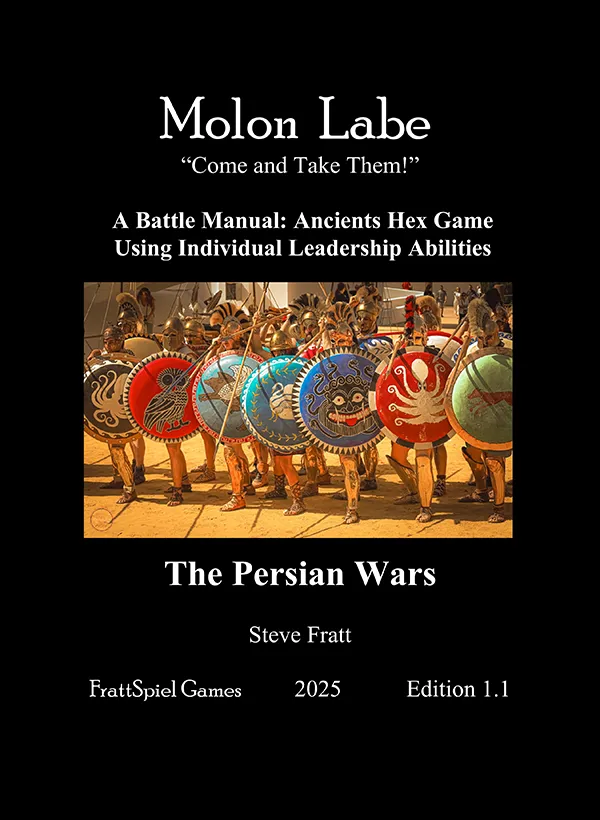
Molon Labe: "Come and Take Them!"
$32.00
Command and Colors is a great introductory system for war gaming. The best thing about it is that is spans the ages with the same basic gaming engine. This allows for players to jump in at any era and have a basic understanding of how to play. I have used the system to run games across the ancient and medieval worlds in my classes. Then I started thinking about the Leaders in the game. They have tactical benefits for adjacent or attached units so why not expand their role in the battle?
I found an application a few years ago while working on the battle of Arbela. Leadership was asymmetrical in this battle. The Persians had only three Leaders while the Macedonians enjoyed six. Each leader had a radius of command and a number of unit activations they may achieve per turn. But the Persians needed Leadership values that allowed them to maneuver their massive army in the early stages of the battle. Persian tactical doctrine required the infantry to shower the enemy with arrows to fix their position. Then the excellent Persian cavalry would double envelope the stationary enemy to win the battle. To represent this doctrine I gave the commanders special abilities unique to their person, activated by playing additional command chits. For example, I allowed Bessus on the Persian left and Mazeus on the Persian right to activate all cavalry contiguous to their Leader and move all of them as one, then battle each one individually. The Persian player had to pay two activation chits instead of one for these wing commanders to move all their cavalry towards the Macedonian rear. Since the ability accounted for contiguous units, the benefit began to fall apart as the cavalry wing broke apart in combat. On the flip side of the equation, the Macedonians, with their six leaders, had more tactical flexibility that gave them an advantage in the end game. What worked for the Battle of Arbela should work across the Greek world in all their battles so FrattSpiel Games is proud to present Molen Labe, the first in a series of variant rules.