Small Deadly Space

Small Deadly Space: An American Civil War Battle Manual
$60.00
Small Deadly Space is a brigade-level game by design. It allows Army and Corps commanders to manage a grand-tactical battle with some necessary tactical skills. Therefore we will focus on the brigade as the unit to which leaders will attend. Division Commanders have a number of Staff Officers attached to their Headquarters stand. These reflect the quality of his ability to “broadcast” his leadership to units locally, as needed. I have deliberately chosen to highlight the function of sending leadership into combat situations instead of establishing an umbrella of control for the turn. Units move straight forward and will need Leaders to send Staff to assist with any nuanced flanking moves. Combat is the actual crucible in which the quality of leadership is tested in battle. Too many battle rules have gotten this “inside-out” – more detail at the high command level [thus wasting player time] and less detail in combat, usually portrayed by a few modifiers to the poor, overloaded, d6! Staff Officers may be sent from the HQ Tray at the gallop to guide unit movement, urge a unit on in combat, or assist in its rallying. This approach will help make quality of leadership tangible and intuitive as players handle their troops.
Review: Wargames Illustrated May 2024
We sent our Observation Post skirmishers through On Military Matters’ book library and they returned with this report!
SMALL DEADLY SPACE SECOND EDITION
Small Deadly Space 2.0 is an American Civil War battle manual by Steve Fratt that takes an interesting look at the subject matter. Rather than dedicate his attention to the physical factors of warfare, the author (who, as a published Civil War combat historian, a college professor of Military History, and a 20-year veteran of Civil War re-enacting, is not lacking in pedigree) chooses to focus on the psychological.
Morale and cohesion are tracked on hidden dashboards, and act as a primary factor of friction. Division Staff Officers can rally the troops to bring them up, but defeats and fatigue will lower totals, and morale is a key element in the game. It determines whether your men go in, or settle for a protracted firefight, while defenders test against it to determine how much defensive fire they can put out.
This is wargaming where leadership and troop psychology is key. If an attack looks like it might stall, t};len a Staff Officer can rush to join, allowing the attackers to reroll the Close Action dice that determine possible success. Only when a two-to-one result is achieved will a Close Action be decided, which may require more Staff Officers joining the fray. At the end of the turn, every unit that was in combat tests their current morale to see if troop stands are removed from play.
That is, of course, just the tip of the iceberg in what is an extremely dense ruleset. The author is unrelenting in detail, with each possibility given specification aplenty; this will greatly appeal to some, but be equally off-putting to others. We certainly felt that getting the exciting bit – the rules
– front and centre before tens of pages on different stands and scales would increase the appeal, but you can’t fault the thoroughness, with everything getting a photograph to enhance the description. This slightly odd order of rule presentation, along with the inexplicably oversized text given to the game’s name every time it is mentioned, are really our only major criticisms, though.
The author has taken a different approach to battle here, and created a system that flips the focus of players, making the psychology of battlefield trauma a hugely deterministic factor on control and command. The depth here is demanding, and, if you’re after a quick pick-up-and-play game, you should certainly look elsewhere, but the systems will reward patient players with a wealth of simulation options.
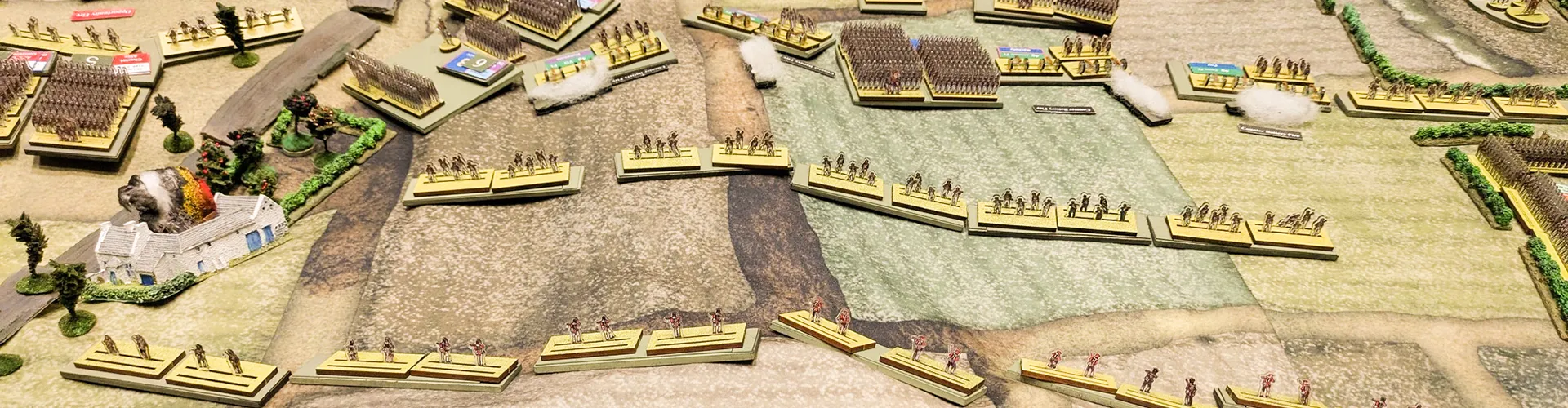
We also must applaud the number of gameplay examples, all illustrated through photographs showing the author’s 6mm Heroics and Ros collection, that bring clarity to a lot of the text.
Photographs of re-enactments add to the history and overall informative tone here, too; this will be a good reference book as well as a ruleset.
If the depth of the core game isn’t enough to satisfy your search for realism, how about heading to the Kriegspiel section for optional rules? Want 14 pages on the nuances of cavalry? You’ve got it! These Kriegspiel games get a whole new section on phases, bringing a wealth of extra battlefield friction to the game.
With its section on history, a bibliography, and various appendices, this might be the only book you need for your ACW wargaming.
DETAILS
- Scale: Scale agnostic
- Period: American Civil War
- Price: $60
- Format: 174-page full-colour softback wirebound
- Available from: onmilitarymatters.com DETAILS
- Scale: Scale agnostic
- Period: American Civil War
- Price: $58
- Format: 174-page full-colour softback wirebound
- Available from: onmilitarymatters.com